What follows is a blog posting from Blog A Go-Go. I just discovered the blog last night and find the writer's entries interesting and fascinating; her writing is amazingly facile. I encourage you to check it out.
November 24, 2007
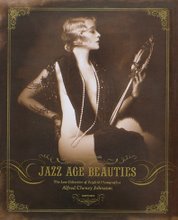
I have just devoured one of the most beautiful books I have ever seen. It's Jazz Age Beauties: The Lost Collection of Ziegfeld Photographer Alfred Cheney Johnston and it is magnificent. It was written by Robert Hudovernik, which you would hardly know from looking at the cover. (His name is in modestly tiny print, melding into the bare thigh of the lace-draped model in the photograph.) If you are one of those shy, wallflower types who think the undraped female form is inherently indecent, I beg you to log off now and go lie down. If, however, you can appreciate the artistic nude, then read on.
The subject matter of Johnston's photographs would have been compelling even if they had been fully clothed. The Ziegfeld girls were legend in the Jazz Age, shattering the wholesome allure of the Gibson Girl and bringing a spicy eroticism to the commercialization of the female image. As Hudovernik points out, Ziegfeld perfected the girls in his Follies, each year choosing the very best from the thousands who auditioned, selecting the most beautiful gems to sparkle on his stage. At first they were petite, with small breasts and tiny feet. Later, Ziegfeld began casting taller, more statuesque, deep-bosomed girls, the forerunners of the Vegas showgirls. Ziegfeld girls were the first to carry off enormous headresses, to bedeck themselves in electric lights, to enter riding ostriches and horses, or to strut down glass catwalks suspended above the theatre-goers' heads. Draped in furs and feathers and jewels, they conjured a thousand fantasies, and made most of them come true.
They lived large, the Ziegfeld girls, and there were whispers of a curse. Many of them died in tragic circumstances, some at appallingly young ages. They ran through lovers and husbands like so many uncut diamonds slipping through their fingers, and they spent money with abandon, wrecking fortunes and wasting their own beauty. Some were damaged in car accidents, some committed suicide; there was one who died from lacing her corset too tightly, and another from a heart complaint brought on by dancing too much. They burned brightly and for a very short time, but in those heady, extravagant years, Alfred Cheney Johnston captured their luminosity on film.
The pictures themselves are a revelation. If you thought that beauty in art ended with "The Mona Lisa", you have only to look at one of his photographs to have your faith restored. For all that he was photographing the most notorious nudes of the day, Johnston clearly kept a reverent eye upon the composition and lighting of his photographs. He was reputedly inspired by the curved forms in nature--the curl of a wave upon the shore, the arch in a nautilus shell--and that is apparent by the perfection of line in his models. They described how Johnston would gently adjust and re-adjust the composition until it was perfect, the line of one limb leading to another, until the eye was drawn back to the face. That fact alone saves the photographs from being prurient. There are hundreds of photos in the book; only a mere handful show full frontal nudity, and even those are as tasteful as any Grecian goddess. There is even an observation from a gentleman who visited Johnston's studio as an impressionable boy of eight. He noticed the naked images of women stacked around the room, and his assumption was that they were angels. It is an easy mistake to make; the quality of the light is ethereal and caressing, and there is something completely untouchable about these women.
One curator, viewing the collection, said that they were so beautiful, they made him shiver. One sympathizes. It is impossible to look through the book without being moved by so much beauty in one place. So, when the world seems like a harsh and ungentle one, find a copy of this book and immerse yourself in a time that was much more glamorous and infinitely interesting. Me, I'm going to find an ostrich to ride.
from Blog A Go-Go
Showing posts with label Alfred Cheney Johnston. Show all posts
Showing posts with label Alfred Cheney Johnston. Show all posts
Saturday, December 01, 2007
Monday, September 03, 2007
FREE EBOOK WHEN YOU SUBSCRIBE

Hello Everyone, it's Labor Day 2007 , late afternoon and hopefully everyone has had a terrific long weekend and you are all arriving home safe and sound. Just a note to let you know that I've put together a FREE EBOOK on 17 of Alfred Cheney Johnston's photographic techniques. Just sign up for the Alfred Cheney Johnston Newsletter and the ebook will be your's in a matter of minutes.
Even though my book "Jazz Age Beauties" has been published I continue to do research into the work of ACJ. In the 17 PHOTO SECRETS of Cheney's work I've brought to light what I've gleaned from the study of his amazing images.
Even though my book "Jazz Age Beauties" has been published I continue to do research into the work of ACJ. In the 17 PHOTO SECRETS of Cheney's work I've brought to light what I've gleaned from the study of his amazing images.


Tuesday, July 31, 2007
What's In A Name?
When I started getting serious about writing a book on Alfred Cheney Johnston I felt I needed a working title to help keep me anchored to ACJ’s story as I researched and wrote the essays. I settled upon “The Line of Beauty”. The line of beauty is a classic principle historically taught in fine art schools. As I wrote in my essay about ACJ’s use of the line of beauty, “…this compositional theory based on the idea that curvilinear forms in nature, such as of an incoming wave or a nautilus shell, are more beautiful than non-curving forms.” Look at almost any photograph Alfred Cheney Johnston took and you will see his utilization of “the line of beauty”.
Shortly after signing my book contract my editor wanted us to brainstorm some title ideas for what the publisher had decided would be the definitive book on Alfred Cheney Johnston. Of course the “only” title I wanted was ‘The Line of Beauty”. I sensed immediately that this did not resonate with the publishing house. Besides, upon doing a search on my title idea it was discovered it had already been taken. A book had just come out with that exact title. It was on the Thatcher government in England. To this day I fail to understand the connection between “the line of beauty” and English government.
That’s not to say that we still couldn’t have gone ahead and used that title but the publisher feared from a marketing standpoint it would cause confusion amongst the buying public. Alas I had to say good-bye to the title I had my heart set upon, “The Line of Beauty”. Building a book, after all, is a communal process between publisher, editor, the marketing department and the author. You win some and you lose some but in the end everyone’s aim is to put out a beautiful book that catches the eye as well as the imagination of the public. And the title of a book is one of it’s most important calling cards.
Subscribe to:
Posts (Atom)